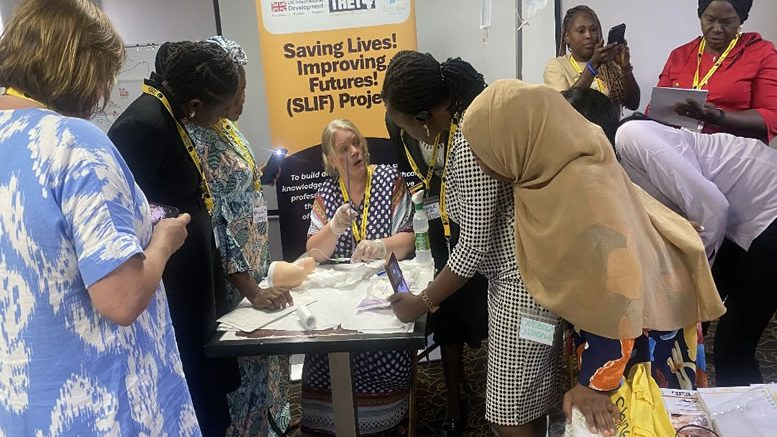
Saving Lives! Improving Futures (SLIF) Project (Continence Management)
Background: (2017
Background: (2017 till Date)
Having one form of disability or the other comes with some underlying health challenges, and among this is difficulty in controlling the movements of the bowels and bladder for persons with Spina Bifida.
Spina bifida is a complex, congenital condition that requires lifelong management and babies born with spina bifida will have some degree of bowel and bladder incontinence (inability of person to have control over passing of urine or faeces in a socially acceptable and hygienic way.
Without access to trained professionals, equipment, and support for good and hygienic continence care and management, many experience recurrent urinary tract infections, kidney infections and, sadly, some will die due to kidney failure.
This is hugely exacerbated in Nigeria and other West African countries, due to lack of access to services, poverty and stigma.
Children, young people and adults with spina bifida also face extreme social exclusion, lack of education and very limited life opportunities. Women and girls, often the primary caregivers, withstand the most of this burden.
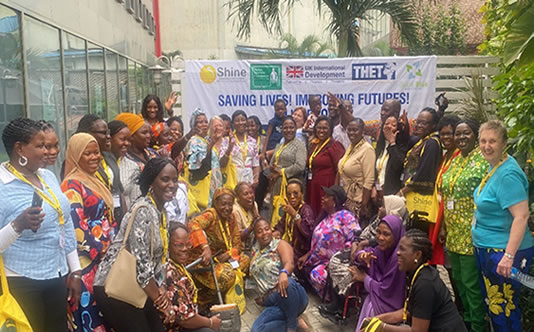
‘Saving Lives! Improving Futures’ is our flagship project to improve continence care and management for babies, children, young people, and adults living with spina bifida in Nigeria.
Working in partnership with Shine UK, the national charity for people with spina bifida and hydrocephalus in England, Wales and Northern Ireland, the focus of our project has been on developing the skills and knowledge of healthcare workforce in Nigeria, focusing on improving care and health and education outcomes for babies, children, young people and adults with spina bifida. It addresses the complex challenges faced by individuals with spina bifida by empowering healthcare professionals and building a sustainable support network for individuals and families.
Four areas of continence management covered under our SLIF Project:
Clean Intermittent catheterisation (CIC) – draining the bladder on a regular basis to reduce the risk of urinary tract infection (UTI) and kidney damage.
Bowel washouts – to evacuate the faeces daily to prevent soiling, and to avoid build-up of stool in the lower bowel which can impact on the health of the bladder.
Measuring bladder pressure – monitoring the pressure within the child’s bladder to document the behaviour of the bladder and allows the success of the treatment to be measured.
Instillation of Oxybutynin – anticholinergic medicine to reduce bladder overactivity by relaxing the bladder muscles. This reduces wetting and preserves renal function.
Project Achievements:
To date, the partnership project has:
- Provided continence care to 300 babies, children, young people, and adults living with spina bifida in Nigeria.
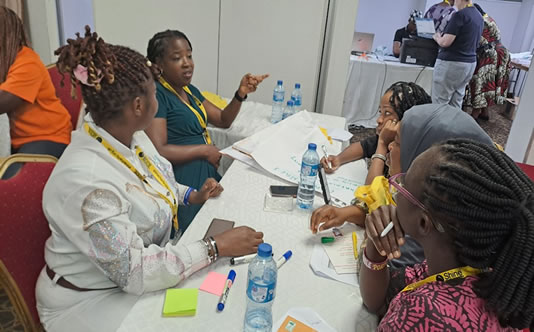
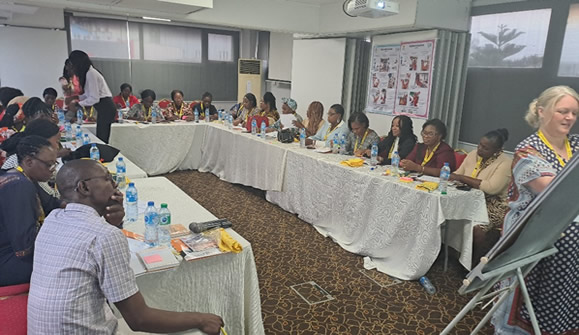
- Trained 120 healthcare workers across 11 public health facilities in 10 states of Nigeria and FFF clinic.
- Established continence clinics in 10 public tertiary hospitals.
- Supported the FFF continence clinic in Lagos.
- Recruited and trained 5 lead nurses to develop their leadership skills and knowledge to help with project sustainability and growth.
- Carried out 230 outreach visits for 174 Nigerian babies, children, young people and adults with spina bifida.
- 205 hospital-based clinics to support 291 Nigerian babies, children, young people and adults with spina bifida.
- Imported Oxybutynin, a vital medicine to help with bladder management.
- Purchased catheters so that all project beneficiaries have access to a new catheter at least once a month pro-bono.
- Supplied hospitals with equipment to aid the running of the clinics (catheters, cones, bowel wash out kits, weighing scale, burette set, manometers and valves, etc).
- Production of sustainable resources including jingles (https://youtube.com/shorts/41qkNSTCJWI?feature=share) and documentary (https://www.youtube.com/watch?v=H1kd63a0Rtk) for continuous education and to showcase learning and impact of good continence practices.
- Secured the Federal Ministry of Health’s commitment to integrate spina bifida and hydrocephalus into Nigeria’s national health and disability frameworks.
Project Partners: - Lagos University Teaching Hospital (LUTH)
- Lagos State University Teaching Hospital (LASUTH)
- University College Hospital (UCH)
- Obafemi Awolowo University Teaching Hospital Complex (OAUTHC)
- University of Benin Teaching Hospital (UBTH)
- Rivers State University Teaching Hospital (RSUTH)
- Federal Medical Centre, Umuahia
- University of Abuja Teaching Hospital (UATH)
- Usmanu Danfodiyo University Teaching Hospital (UDUTH)
- University of Ilorin Teaching Hospital (UITH)
- University of Nigeria Teaching Hospital (UNTH)
Donors/Grantors:
- Global Health Partnerships/Department of Health & Social Care UK– February 2024 – August 2025
- Gay & Keith Talbot Trust U.K – August 2023 – July 2024
- Wales for Africa Hub (Hub Cymru Africa) – 2016, 2017
- International Federation for Spina Bifida & Hydrocephalus (IFSBH) – 2016
- Child Help International (CHI) – 2018, 2024
Published article/story about the project – https://www.globalhealthpartnerships.org/improving-continence-care-for-people-with-spina-bifida-in-nigeria-lawals-story/
Wants to support this project.
We’re looking at how we can work together to reach more babies, children, young people and adults with spina bifida in Nigeria – and eventually Ghana and other West African countries IF we can secure some funding to do it.